
Closed-cell and open-cell foam
Spray Foam Insulation in Kalamazoo, MI
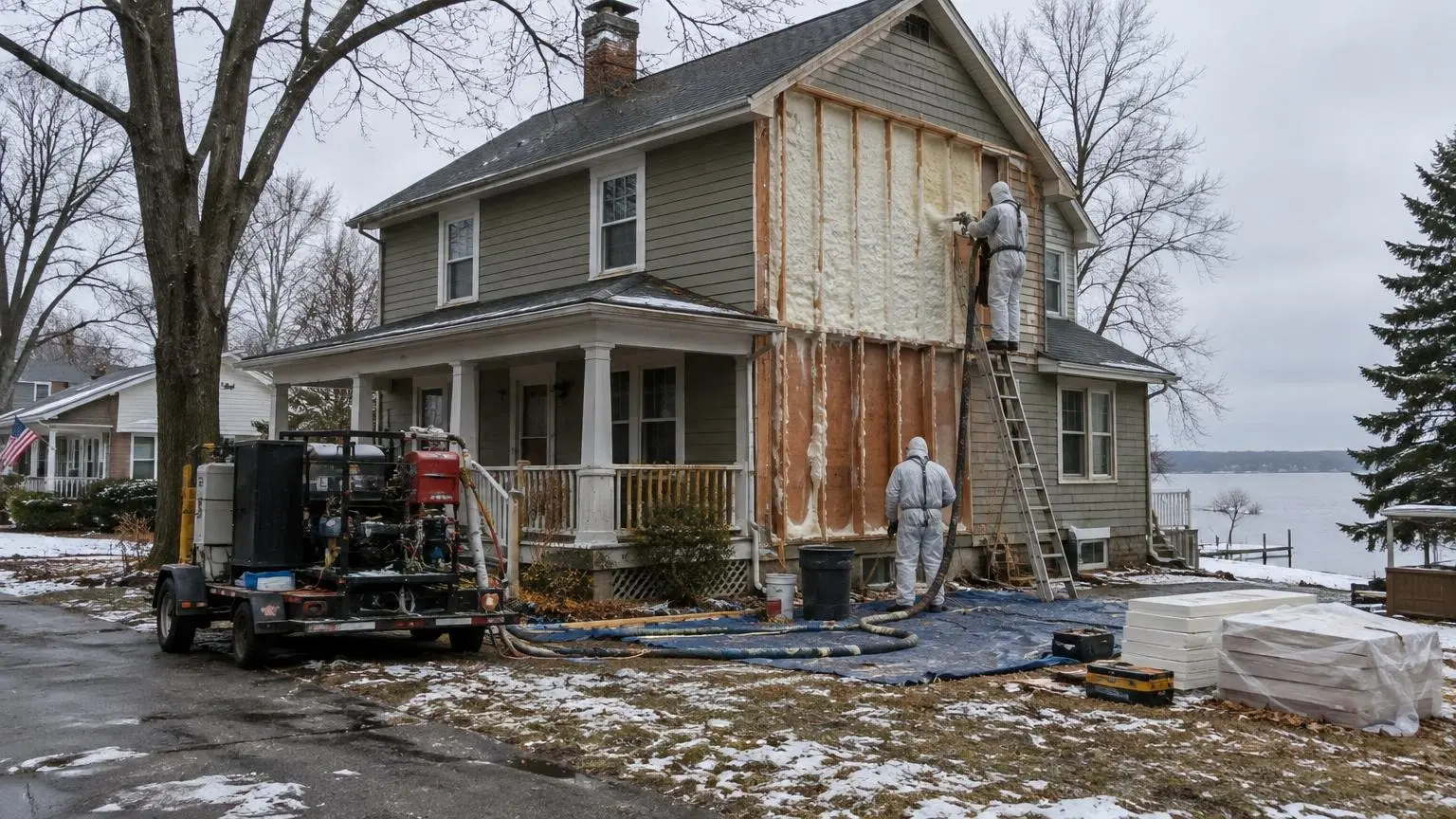
The right foam for each surface: dense closed-cell where cold and moisture meet, lighter open-cell where sealing and sound matter most.
- Free estimates after an on-site look
- Every area quoted with its material, thickness and R-value
- Moisture, wiring and leak problems pointed out before we cover anything
One Material, Two Very Different Foams
Spray foam insulation goes on as a liquid, expands into cracks and gaps, and cures in place, so it insulates and blocks air movement in a single step. In Kalamazoo, where the airport's 1991-2020 normals show a January average low of 18.1F and a record low of -22F, that air seal does as much for comfort as the R-value. We install both closed-cell and open-cell foam, and picking between them is the first call on every job.
Closed cell vs open cell, in plain terms
Closed-cell foam cures into a rigid, dense layer. HomeGuide lists it at R-5 to R-7 per inch. At typical thickness it slows water vapor, sheds liquid water and stiffens the surface it is sprayed on. Open-cell foam is spongy and light, rated around R-3.5 to R-3.7 per inch, and it expands far more, filling irregular cavities and damping sound. Because vapor can pass through it, open-cell in a Zone 5 climate needs a vapor retarder or a design that lets the assembly dry.
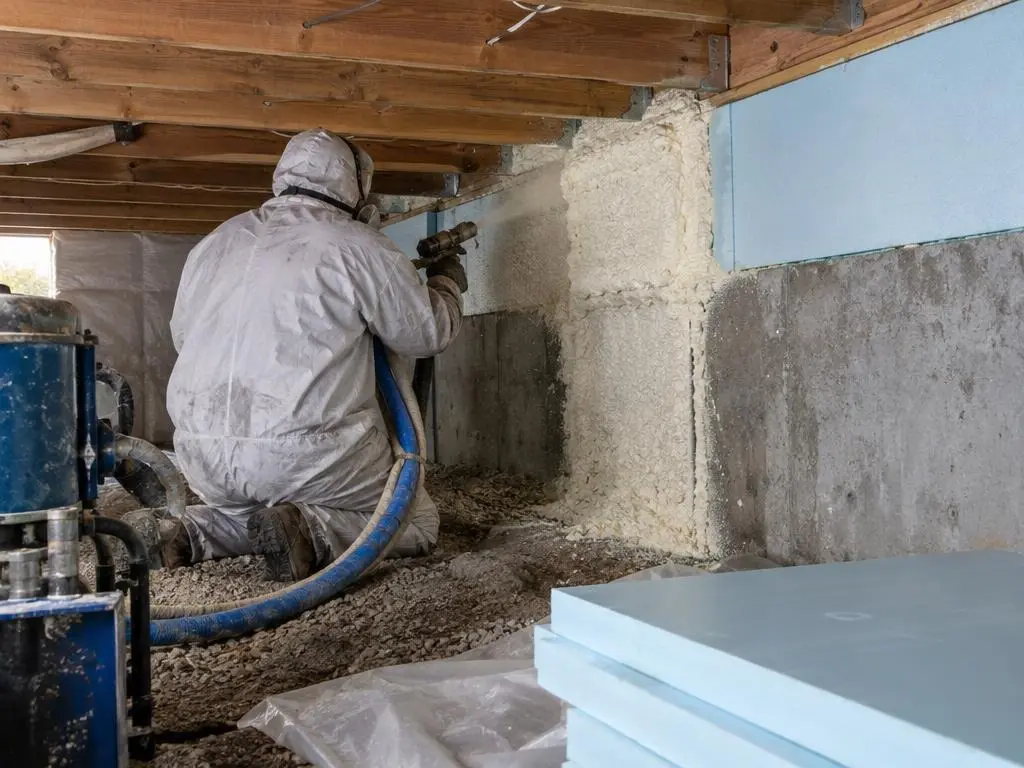
In practice, closed-cell goes where cold surfaces and moisture meet: rim joists, basement and crawl space walls, the underside of roof decks in vaulted ceilings, and the steel of pole barns and shops. Open-cell goes in interior and exterior wall cavities during remodels, between floors, and in some attic rooflines where the moisture plan is sound.
Where foam earns its cost in a Kalamazoo house
The rim joist is the most common spot. It wraps the whole basement at the top of the foundation wall, it is often bare wood or has a loose batt pushed against it, and it lets cold air in all winter. Two to three inches of closed-cell foam seals and insulates it in one pass.
Older homes in the city's historic neighborhoods add their own list: open framing bays between floors that act like chimneys, kneewalls in story-and-a-half houses, sloped ceilings in finished attics, and porches that were closed in decades ago. Newer homes in Portage and the townships tend to need foam at bonus-room floors over garages, cantilevered floors, and the band joist between stories.
Vaulted ceilings and steel buildings
Where a ceiling follows the roof line and there is no attic, getting enough R-value with fiberglass while keeping a vent channel is tough. Closed-cell foam against the underside of the roof deck can insulate and air seal without the vent space. In pole barns and metal shops, foam on the steel stops the condensation that forms whenever warm, damp inside air meets cold metal.
When foam is the wrong choice
Foam will not fix a leak; it hides one. Roof, window and plumbing leaks get repaired first. Foam is also not the cheapest way to insulate a wide-open attic floor; sealing the bypasses and blowing in cellulose or fiberglass usually costs less for the same R-value. And we do not cover knob-and-tube wiring or vermiculite that might contain asbestos until it has been checked. If we see any of these, you hear about it before you see a price.
Getting ready and getting back in
Spraying goes quickly; prep and cleanup take longer. We cover floors and belongings, mask windows and outlets, and ventilate the space. HomeGuide advises staying out for 24 hours or more while the foam cures, so a basement job may mean a night away, while a detached garage or barn may not affect the house at all. In cold months we plan around the temperature limits of the material.
Fire protection
Exposed foam in living spaces, attics and crawl spaces generally needs a thermal or ignition barrier, depending on the space and the product. We tell you what the space needs and include it in the estimate, so nothing is left out.
Call (269) 230-2389 or request an estimate, and we will measure the spaces and recommend a foam for each. Get a free estimate
What This Covers
The places we spray most, and the foam we usually choose for each.
Rim and band joists
Closed-cell sprayed along the top of the foundation wall to stop the cold drafts that sneak in around the whole basement.
Rooflines and vaulted ceilings
Foam on the underside of the roof deck where there is no attic, sized to reach the R-value the space needs without a vent gap.
Walls during remodels
Open-cell or closed-cell in open stud bays when plaster or drywall is off, often the only time old walls are easy to insulate.
Garages, bonus rooms and cantilevers
Foam in floors over garages and in overhangs, sealing out cold air and garage fumes together.
Pole barns and steel buildings
Closed-cell on metal walls and roofs to insulate and stop condensation drip.
Air sealing before blown-in
Foam at top plates, chases and penetrations in the attic before loose fill goes on top.
Published Spray Foam Insulation Costs
| Job | Range and source |
|---|---|
| Spray foam, installed | $1.50 to $5.00 per sq ft (HomeGuide) |
| Open-cell / closed-cell | $1.50 to $3.50 / $3.00 to $5.00 per sq ft (HomeGuide) |
| Roughly 1,000 sq ft | $1,500 to $5,000 (HomeGuide); $3,150 to $7,500 in an existing home (Fixr) |
| Existing walls / new construction | $3.15 to $7.50 / $2.75 to $6.50 per sq ft (Fixr) |
| All exterior walls | $4,000 to $10,000 (HomeGuide) |
| Whole house | $8,000 to $20,000 (HomeGuide); $10,000 to $30,000 (Fixr) |
| Common job minimum | $1,000 to $2,000+ (HomeGuide) |
National ranges from HomeGuide's 2026 guide and Fixr's 2025 guide, not Kalamazoo prices. Foam type, thickness, access, prep and barrier coatings move the total, and small jobs often hit a minimum. A Consumers Energy rebate, if you qualify, comes off after the fact. You pay the amount on our written estimate.
How It Works
1. Walk-through
We inspect each space, measure it, and check for leaks, damp wood and wiring issues.
2. Written plan
You get an estimate listing foam type, thickness, R-value and price for every area.
3. Prep and spray
We cover and mask, ventilate, and apply the foam in passes to the specified depth.
4. Barrier and cleanup
Any required thermal or ignition barrier goes on, trimmings are cleaned up, and we walk the work with you.
Why Choose Us for Spray Foam Insulation
Foam where it pays
If blown-in or simple sealing does a space for less, we say so.
Depth in writing
Thickness and R-value are on the estimate for easy comparison.
Moisture first
Leaks and wet framing get flagged before anything is covered.
Spray Foam Insulation Questions
How thick does closed-cell foam need to be on a rim joist?
Two to three inches is common, which gives roughly R-10 to R-21 using HomeGuide's R-5 to R-7 per inch. We size it to the space and your goals and write the thickness on the estimate.
Does spray foam smell after it is installed?
There is an odor while the foam cures, which is why HomeGuide advises staying out for 24 hours or more. We ventilate during and after the job and tell you when it is fine to go back in.
Can spray foam go over old insulation?
Usually the old material comes out first so the foam can bond to the framing or deck. In an attic floor, we may leave sound insulation in place, seal the bypasses around it, and add loose fill on top.
Who manufactures spray foam insulation?
Several national chemical companies make two-part spray foam systems for contractors. What matters more for you is the foam type, its rated R-value per inch and the thickness installed, all of which we list on the estimate.

Spray Foam Insulation Service Areas
- Spray Foam Insulation in Kalamazoo, MI
- Spray Foam Insulation in Portage, MI
- Spray Foam Insulation in Oshtemo Township, MI
- Spray Foam Insulation in Texas Township, MI
- Spray Foam Insulation in Kalamazoo Township, MI
- Spray Foam Insulation in Comstock Township, MI
- Spray Foam Insulation in Parchment, MI
- Spray Foam Insulation in Richland, MI
- Spray Foam Insulation in Galesburg, MI
- Spray Foam Insulation in Augusta, MI
- Spray Foam Insulation in Vicksburg, MI
- Spray Foam Insulation in Schoolcraft, MI
- Spray Foam Insulation in Plainwell, MI
- Spray Foam Insulation in Otsego, MI
- Spray Foam Insulation in Allegan, MI
- Spray Foam Insulation in Paw Paw, MI
- Spray Foam Insulation in Mattawan, MI
- Spray Foam Insulation in Lawton, MI
- Spray Foam Insulation in Three Rivers, MI
Get a Spray Foam Insulation Estimate
Tell us which spaces feel cold, and we will recommend a foam for each one.